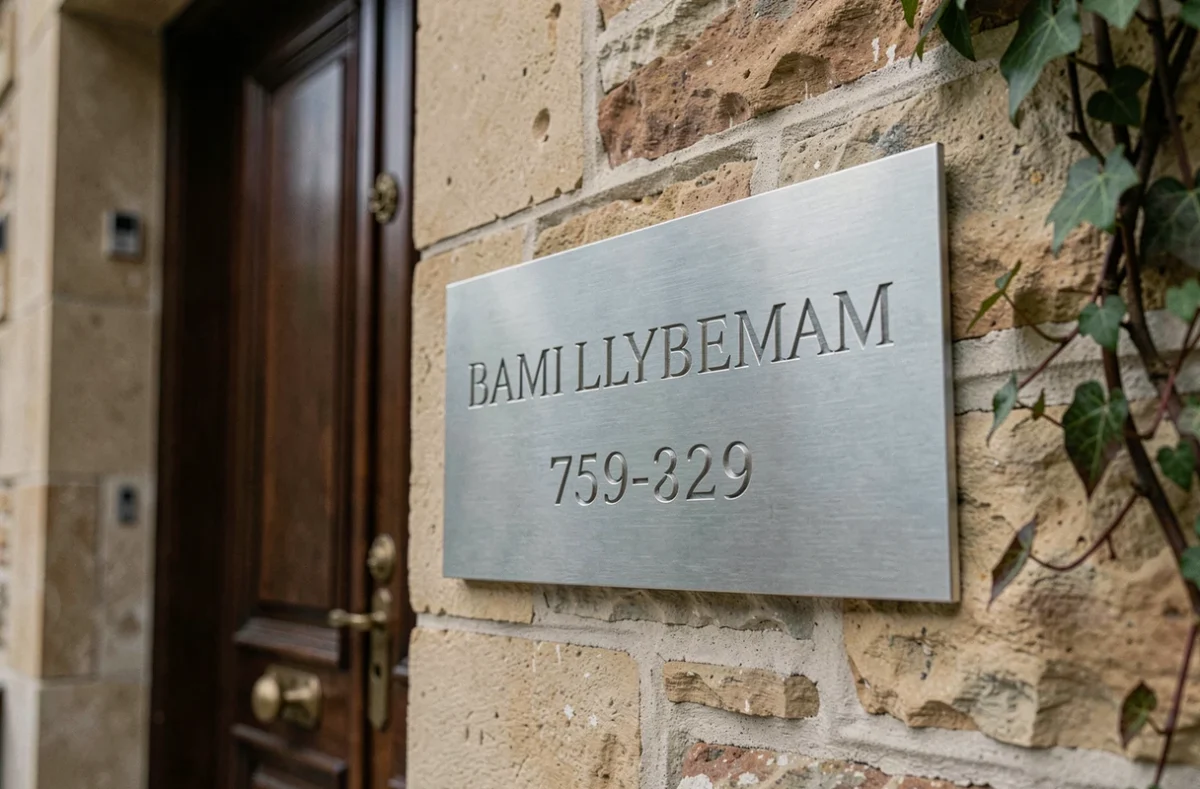
Laser engraving on a family mailbox plaque is not just an aesthetic choice. It is primarily a matter of durability, material compatibility, and readability from a distance. We will detail the technical parameters that make the difference between a plaque that ages well and an inscription that becomes unreadable after two winters.
Laser-Material Interaction: What Determines the Durability of the Engraving
The principle relies on localized heating of the surface, brought to a temperature close to the melting point of the material. This thermal process causes a color change through oxidation, without removing or adding material. The marking obtained is therefore integrated into the very structure of the support.
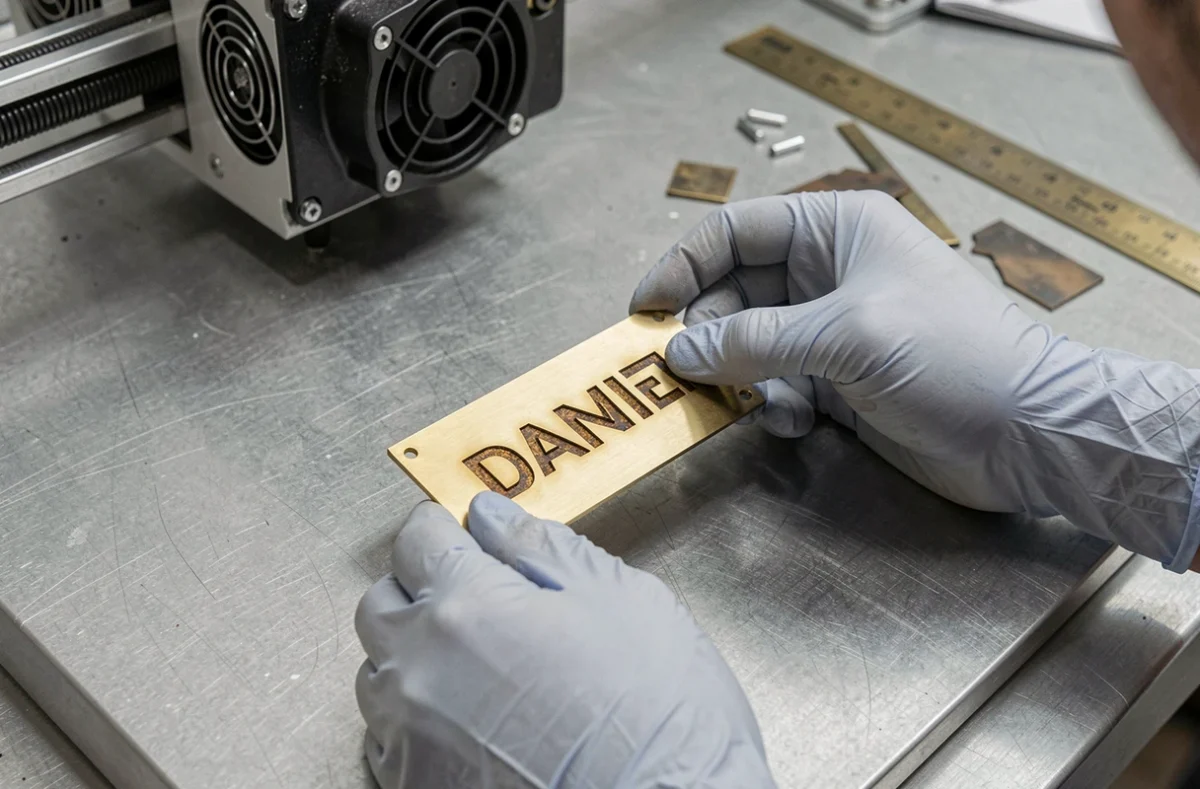
On a PVC plaque, the beam vaporizes a thin superficial layer to reveal the background color. On anodized aluminum, it modifies the surface oxide without attacking the underlying metal. On brass or copper, the power and speed of the laser produce variable shades depending on the nature of the oxides present in the alloy.
This absence of mechanical alteration (no milling, no tip) explains why laser engraving creates no burrs or micro-cracks. A point often overlooked: the micro-cracks on the surface of a mechanical engraving become traps for moisture, accelerating corrosion on metal plaques exposed to the elements.
For a family installing their plaque outdoors, on a gate or a standardized mailbox, this difference is not trivial. We recommend prioritizing laser engraving whenever the plaque will be subjected to freeze-thaw cycles or prolonged UV exposure. You can discover Sidonie & Gédéon to visualize the material-engraving combinations suitable for family use.
Aluminum, PVC, or Brass: Which Material for a Family Mailbox Plaque
The choice of support conditions both durability and visual appearance. Each material reacts differently to the laser beam, and not all are suitable for all locations.
PVC Engraved for Indoor Installations
PVC remains the most common support for mailbox plaques in apartment buildings. Lightweight and inexpensive, it engraves cleanly with a sharp contrast between the surface layer and the core of the panel. However, PVC does not withstand direct UV exposure well over several years. In a building lobby or indoor installation, it fulfills its function perfectly.
Aluminum for Durable Outdoor Use
Anodized aluminum offers a better compromise for a plaque fixed to an individual mailbox outdoors. The anodized layer protects the metal and provides a matte or brushed background on which the laser marks text readable from several meters away. Weather resistance is significantly superior to that of PVC.
Brass and Copper for Heritage Appearance
Brass is intended for house facades where a traditional look is sought. The laser produces warm shades through controlled oxidation. Copper follows a similar logic, with a patina that evolves over time. These materials are suitable for old houses, but their cost and weight make them less relevant for a simple standardized mailbox.
Format, Fixing, and NF D27-405 Standard: Adapting the Plaque to Its Support
We often observe confusion between the compliance of the mailbox and that of the plaque itself. The NF D27-405 standard concerns individual outdoor mailboxes: dimensions, waterproofing, resistance, installation. The NF D27-404 standard applies to indoor installations. An engraved plaque, no matter how durable, does not render a mailbox non-compliant, and vice versa.
The format of the plaque must correspond to the designated location on the mailbox. Most standardized mailboxes have a standard rectangular slot. Before ordering, we recommend measuring this location to the millimeter rather than relying on generic dimensions displayed online.
The fixing deserves the same attention as the material:
- Double-sided adhesive is suitable for flat and protected surfaces (building lobby, interior door), but loses its stickiness under high heat or prolonged humid conditions.
- Screwing remains the most reliable fixing method outdoors, provided that drilling is planned during the plaque’s manufacturing to avoid chipping.
- Notches or integrated slides in standardized mailboxes allow for quick replacement without tools, which is convenient for blended families or tenant changes.
Text Engraved on Family Plaque: Readability and Postal Rules
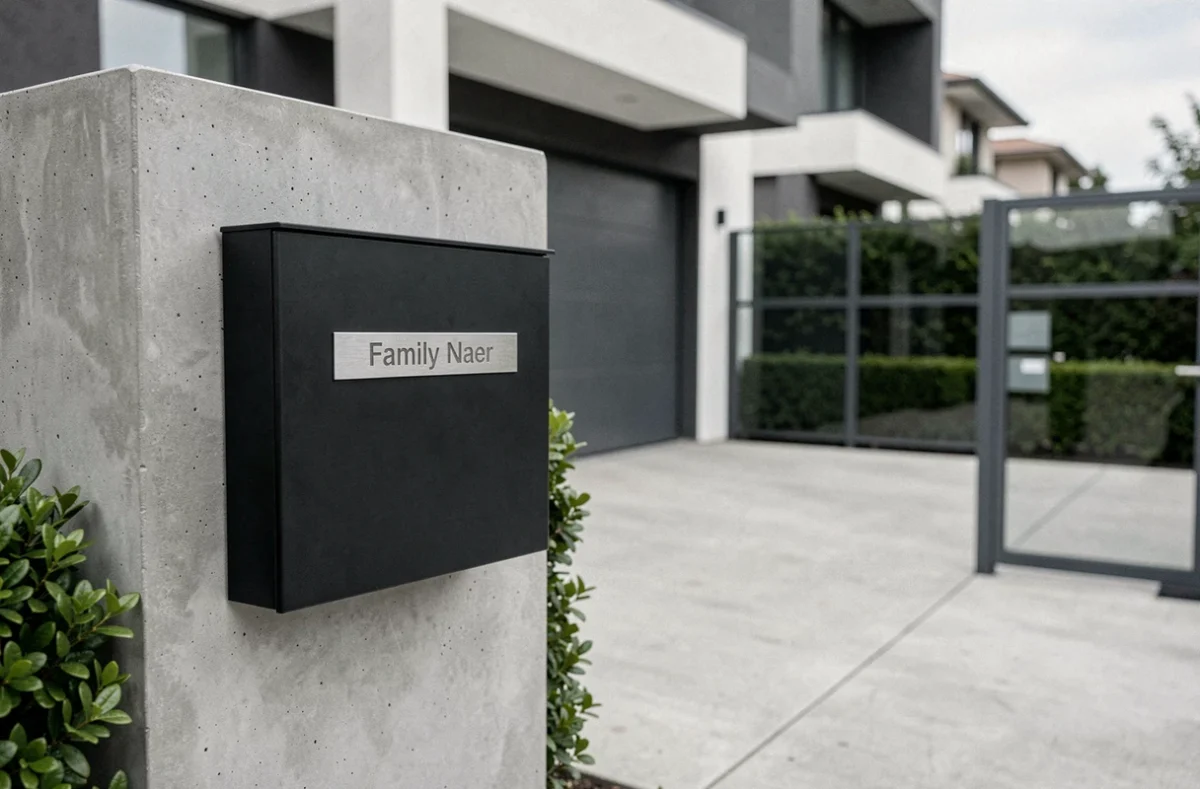
The readability of a mailbox plaque directly affects the proper delivery of mail. The postal service recommends clear marking of the family name, and if applicable, the apartment number, floor, or building.
Laser engraving allows for clear characters starting from a height of a few millimeters, which permits the addition of multiple lines on a compact format. For a family with multiple names (unmarried couple, roommates, blended family), this precision is a concrete advantage over a handwritten label or thermal print that fades in a few months.
Some guidelines for the text content:
- Favor the family name in capital letters, followed by the first name in lowercase if space allows.
- Add the apartment number or floor for collective housing, in accordance with the declared postal address.
- Avoid overly thin decorative fonts: the laser faithfully reproduces the outline, but a character that is too thin loses contrast from a distance.
- On a dark plaque, engraved light text reads better in low light (mailbox under an awning, poorly lit lobby).
The obligation to have a compliant mailbox particularly concerns homes for which the building permit application was submitted after July 1, 1979. For older houses, there is no automatic retroactive obligation, but a properly engraved plaque remains the simplest way to ensure reliable identification of the recipient.
The laser also offers the possibility of engraving a small motif or family logo without significant additional manufacturing costs, as the beam follows a vector file. The only limit lies in the minimum size of the motif reproducible on the chosen material.