Henriot Quimper faience refers to ceramic ware produced in the Locmaria district of Quimper, with a history spanning more than three centuries. Among the thousands of pieces made in its workshops, certain categories attract collectors’ attention for specific reasons: attribution to a known artist, an unusual shape, an exceptional design or a limited production period.
Understanding what sets an everyday piece apart from a rare one means knowing a few technical details before beginning your search or making a purchase.
Henriot Quimper signatures and marks: what the back of a piece can tell you
Before considering rarity, examining the back of a piece is essential. The Henriot-Quimper faience factory used numerous signatures over the decades. Each corresponds to a production period and can help establish an approximate date.
The oldest marks, often hand-painted and sometimes difficult to read, indicate pieces made before the industrial mergers of the 20th century. An old handwritten signature points to small-scale artisanal production, which is of particular interest to collectors.
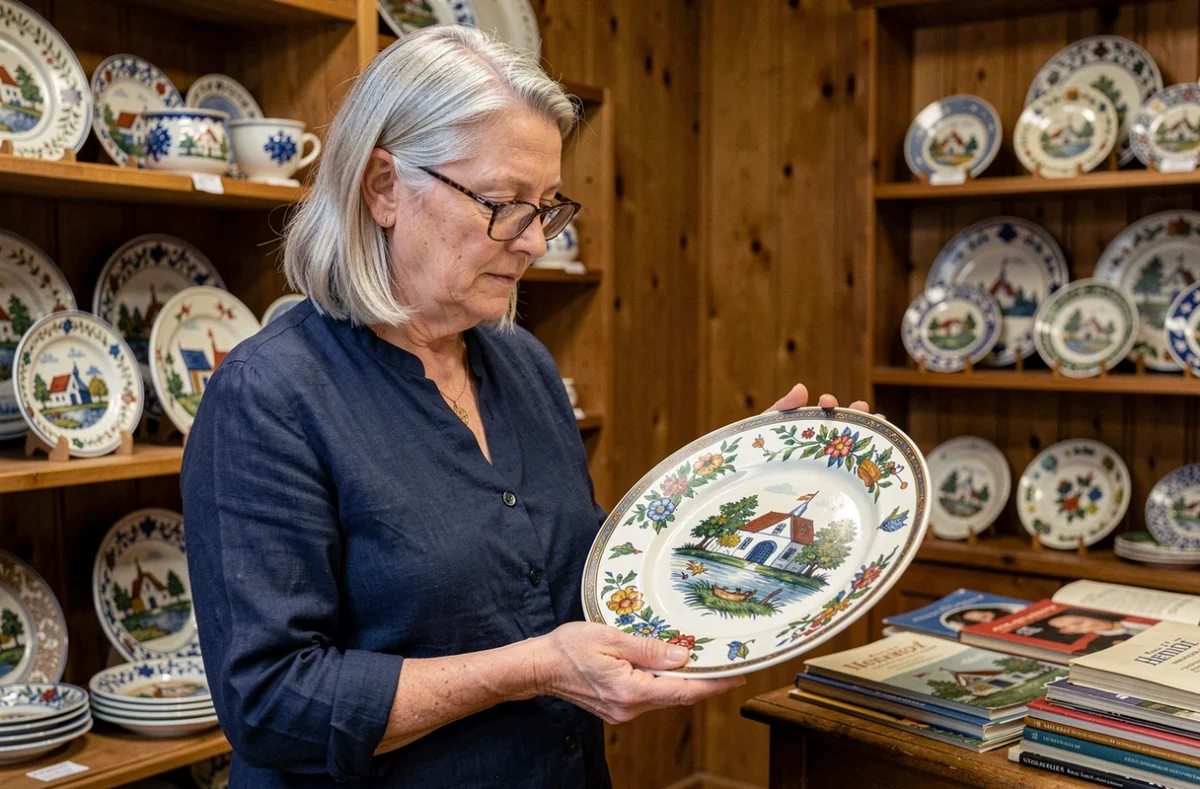
Pieces bearing the double mark “HB” and “Henriot” date from the period after the merger of the Grande Maison HB and Henriot. A piece signed only “Henriot Quimper,” with a model number or an artist’s monogram, offers more clues about its rarity. Browsing a collection of antique Henriot Quimper faience makes it possible to compare these marks visually and refine the identification.
Henriot faience attributed to an artist: the factor that changes its value
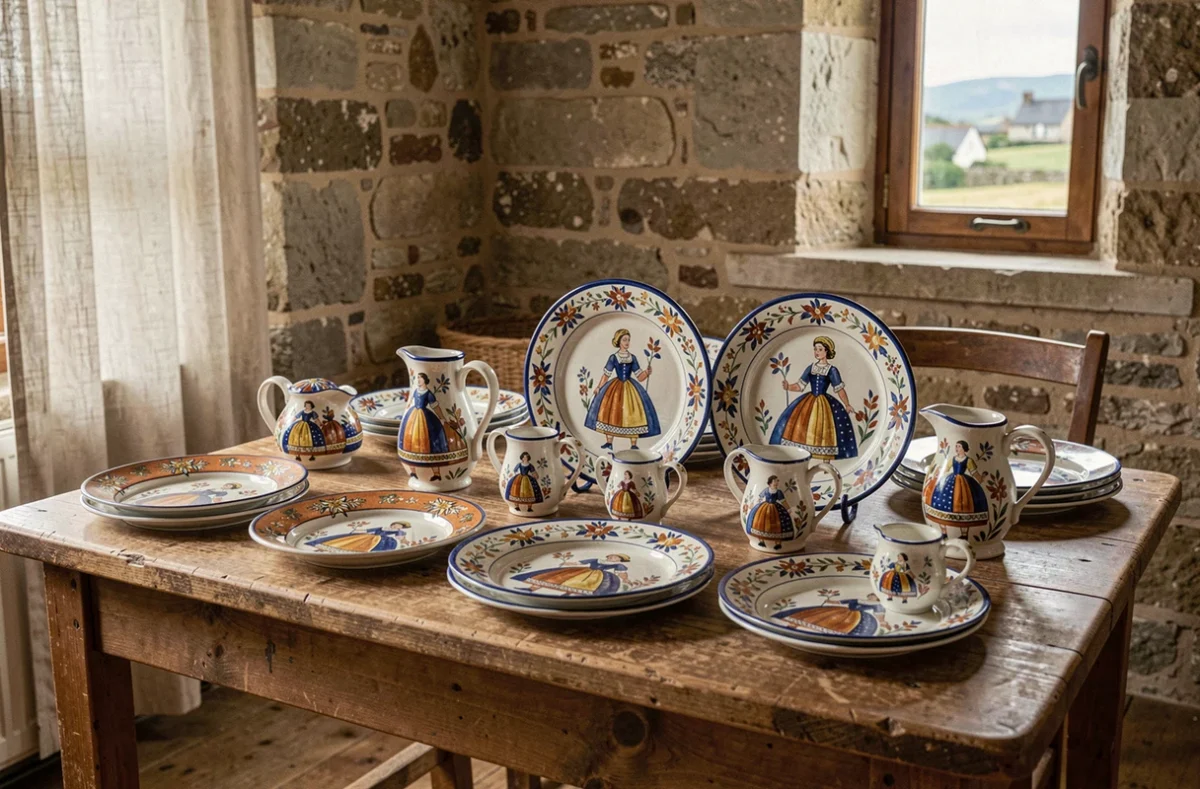
The Quimper faience market clearly distinguishes everyday designs (the little Breton, the Breton woman in a traditional headdress) from pieces created by a named artist. This attribution has the greatest impact on a piece’s value.
Robert Micheau-Vernez is one of the most sought-after names. Auction results document Henriot/Quimper lots attributed to him, with different hammer prices depending on the pieces. Mathurin Méheut and René Quillivic, who respectively led or influenced production at the Porquier and HB factories in the 1920s, are also associated with highly prized pieces.
A reliable attribution rests on three elements considered together:
- The artist’s signature or monogram on the back, in addition to the factory mark.
- A design that matches the artist’s known repertoire (maritime scenes, stylized figures, Art Deco motifs).
- A production date consistent with the artist’s period of activity at the faience factory.
A piece bearing only the Henriot stamp is a factory product. Attribution to a known artist turns a decorative object into a collector’s piece.
Rare shapes and limited editions: beyond plates and bowls
Plates and bowls make up most of the Henriot Quimper production found on the secondary market. Online listings feature several hundred at any given time. This very abundance explains why unusual shapes attract attention.
The most sought-after pieces in this category include faience musical instruments (mandolins, decorative violins), three-dimensional figurines, intricately shaped vases and monumental pieces designed for interior furnishings. One documented auction example is a 19th-century French faience mandolin, possibly from Quimper or Desvres, which sold for several thousand euros.
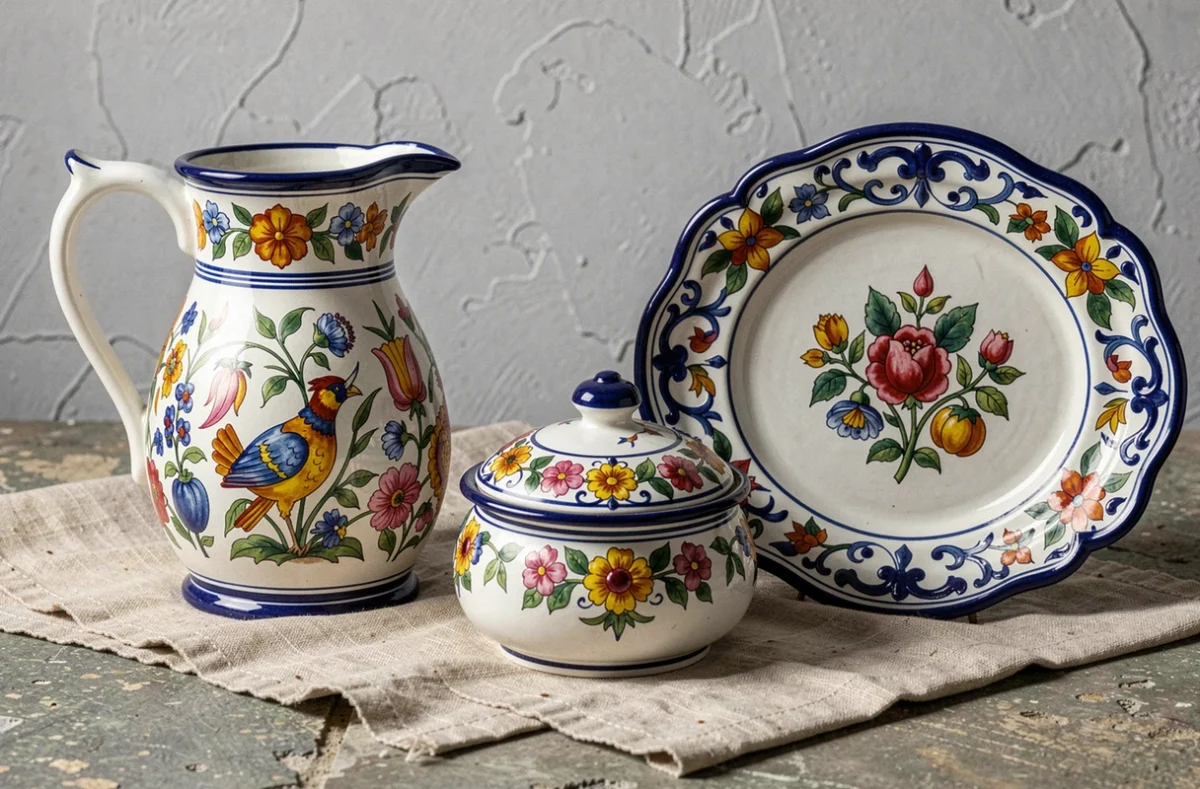
Recent limited editions, such as the Max Jacob series produced by Henriot-Quimper, follow a different logic. Their limited production ensures a degree of rarity, but their value on the secondary market depends on actual collector demand, which remains to be seen over time.
Reproductions of antique designs and one-of-a-kind pieces
The factory offers reproductions of antique designs as well as one-of-a-kind hand-painted pieces. These contemporary creations should not be confused with antique pieces. A reproduction of an antique design is still a new piece, even if it faithfully recreates an 18th-century motif. Experienced collectors always check the actual production date.
Assessing the rarity of Henriot faience: common pitfalls
Prices observed at auction vary widely, even for objects bearing the Henriot-Quimper name. Auction records may include both grouped tableware lots selling for a few dozen euros and figurines fetching several hundred. Buyers commonly make three mistakes.
- Confusing the price of a grouped lot with an individual valuation: online auction results combine sales from multiple countries and platforms, and some listings refer to lots containing several pieces.
- Overvaluing a piece in good condition but with a common design: the Henriot Quimper signature alone is not enough to establish a high value. The model, period and design matter just as much.
- Overlooking condition: a chip, crack or visible restoration reduces value, even for a rare piece. Collectors generally expect condition close to the original.
Auction results are useful comparables, not direct valuations. Comparing a single piece with a lot containing several objects can skew the analysis.
Authenticity and historical imitations
This is not a new problem. As early as the 19th century, the Malicorne and Desvres factories reproduced Quimper designs, creating confusion that persists today. Some pieces sold at auction still cannot be definitively identified by their city of origin. Checking provenance remains the first precaution before making any purchase on the collectors’ market.
The rarity of Henriot Quimper faience is determined by several criteria considered together, never by just one. An antique piece attributed to an artist, with an unusual shape and in good condition, ticks every box. Remove any one of these elements and the object’s position on the market changes considerably.