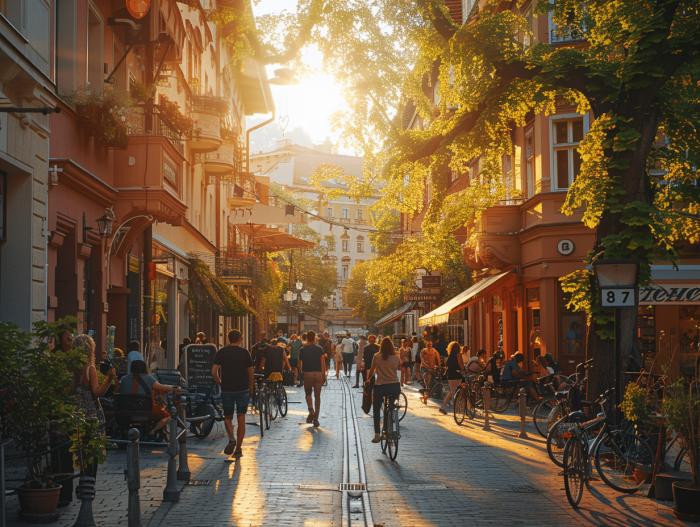
Marseille, the emblematic city of southern France, is often at the heart of debates on urban security. The disparities between its neighborhoods, both in terms of safety and living conditions, attract the attention of many observers. Some areas, such as Panier or Belle de Mai, are experiencing a rise in crime, while others, like the neighborhoods of Joliette or Rouet, enjoy relative stability.
Local initiatives to enhance security are multiplying, but the results remain mixed. Residents, local authorities, and law enforcement are working together to try to curb incidents and improve quality of life. Marseille remains a testing ground for urban security policies in France.
The safest neighborhoods in Marseille
Marseille, often perceived as a city of contrasts, has neighborhoods where urban security is particularly well-rated. Among them, the 5th arrondissement stands out with excellent scores in several key areas.
- Average score: 6.2
- Transport score: 8.4
- Education score: 8.3
- Health score: 7.4
- Environment score: 4
These figures reveal a favorable situation for residents, particularly the middle class, who enjoy a good quality of life.
The 1st arrondissement and the 2nd arrondissement also show respectable average scores of 6. Although these neighborhoods are located in the city center, they provide a relatively safe environment for their residents. These arrondissements benefit from developed urban infrastructure, attracting new residents and solidifying their reputation as safe areas.
The 4th arrondissement and the 6th arrondissement closely follow with average scores of 5.9 and 5.8 respectively. These scores reflect satisfactory urban security, despite some local disparities. The joint efforts of local authorities and residents help maintain valuable stability in these areas, making them attractive for families and young professionals.
Marseille neighborhoods to avoid present considerable challenges, but these arrondissements show that it is possible to live safely in this metropolis. Follow these indicators to assess urban security and consider these neighborhoods as examples to follow for other areas of the city.
The riskiest neighborhoods in Marseille
The northern neighborhoods of Marseille concentrate the greatest social inequalities and suffer from a particularly high sense of insecurity. The 16th arrondissement ranks among the most at-risk areas, with an average score of 1.8. The security score there is alarming: 0.8. This figure illustrates the precariousness and urban fragmentation of this neighborhood.
The 13th arrondissement presents an equally concerning situation, with an average score of 3.4. Although slightly better than that of the 16th, this score remains below the city average. High poverty rates and often failing public services exacerbate social tensions, contributing to a negative perception of security.
Among these neighborhoods, the 10th arrondissement shows an average score of 4.6. This figure, while higher than the previous ones, still highlights significant security issues. Residents frequently express concerns related to crime and the lack of vigilance from local authorities.
These data show stark disparities between the different neighborhoods of Marseille. Efforts to improve urban security must focus on these vulnerable areas. Consider the figures and local realities to assess the needs and priorities in terms of security.